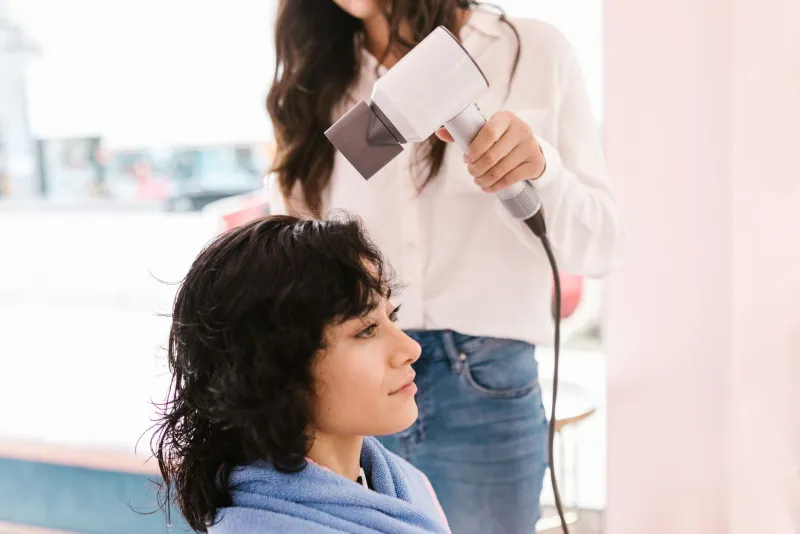
Curls, Coils and a Decent Diffuser: Finding a UK Blow-Dry Bar That Speaks Your Hair's Language
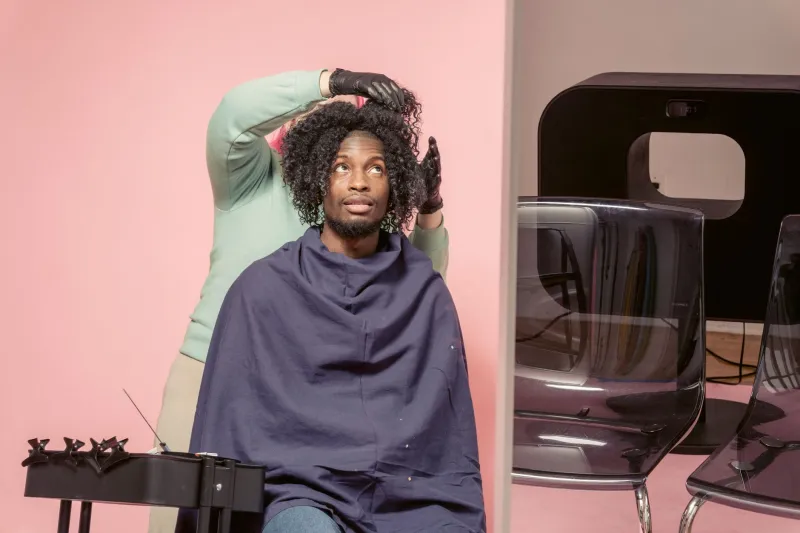
Walk into almost any UK blow-dry bar and the menu reads like a mood board for a single hair type: smooth, bouncy, glossy, big. Brilliant if your hair already behaves that way. Less brilliant if you arrived with a head of 3C coils, a loose 2B wave or a halo of frizz that only appears the moment it rains.
For years the advice to curly clients has been to book a curly cut instead — which is sensible, right up until you want what everyone else wants: an hour of somebody else doing your hair before the Christmas do, a wedding, or the end of a very long week. That's the gap. Cuts, yes. Colour, yes. But a proper, confident, well-priced curly blow-dry? Still a postcode lottery.
Why the standard menu leaves curls cold
Most bars are built for speed. Thirty to forty minutes, one round brush, a couple of tongs, out of the door. Curls need a different rhythm: lower heat, more sectioning, a diffuser or a hood dryer, and a stylist who understands that definition is the goal, not elimination.
Plenty of stylists were trained almost entirely on straight-hair finishing. So a curl gets treated as a problem to be smoothed away rather than a pattern to be worked with. Add in pricing that's often pegged to hair length rather than time — a shoulder-length head of tight coils can take twice as long as fine mid-length hair and still get charged the same — and the whole experience starts to feel like an uphill walk.
What a curl-literate bar actually looks like
The clues are usually there before you book. A website that lists a curly blow-dry as its own menu item, with its own price and its own time slot, is already ahead of the game. So is a team page that names stylists with curl-specific training — whether that's an external curl qualification or a salon's own texture programme.
Look at the photos, too. Not the glossy campaign shots, the real ones. If every head on the grid is smooth and bouncy, the caption promising 'all textures welcome' is doing a lot of heavy lifting.
A good bar will also ask the right things when you call: how you normally wear your hair, how dense it is, how porous, whether you've had a smoothing or keratin treatment in the last year, and how long you want the finish to last. Those questions are the difference between a stylist guessing and a stylist planning.
Diffuser, hood dryer or hand-style?
Most curly blow-dries land in one of three camps.
The diffuser is the quickest and the most familiar. Good for waves and looser curls, brilliant for volume, and usually the route a high-street bar will offer. Ask for low heat and high speed rather than the other way round.
The hood dryer is the one tighter coil patterns tend to prefer. It takes longer — often an hour plus — but it sets the pattern evenly and gives a finish that survives the journey home on the Northern line. It's also the option most likely to be missing from a standard menu.
Hand-styling, or rake-and-shake with a gel cast, is the quiet overachiever. No heat, plenty of definition, and a finish that can be scrunched out at the door. Ask whether they'll do it, because not every bar will.
Then there's the wet-versus-dry question. Some bars will cut wet and diffuse after; others work dry first. Neither is wrong, but a stylist who can explain why they've chosen one for your hair is a stylist worth keeping.
Three bar archetypes worth the detour
The texture specialist. Usually a solo chair or a small studio, often attached to a curl cut. Prices sit around £45–£70 in London and £35–£55 in Manchester, Leeds, Bristol or Glasgow. You're paying for time and training, and it's usually worth it.
The hybrid high-street bar. A standard blow-dry menu with one or two texture-trained stylists hiding in the rota. Check who's on shift before you book — this is the single most useful question you can ask a receptionist.
The diffuser drop-in. Dry bars that offer a 20-minute curl refresh for events. Ideal before a 7.30pm dinner, less ideal if you need a full set from wet.
The questions to ask before you book
- Who on your team is most confident with my texture, and are they working on the day I want?
- How long do you allow for a curly blow-dry, and is that priced by time or by hair length?
- Will you diffuse, hood-dry or hand-style — and can I choose?
- What do you use for hold, and is anything heavy in it?
- What's your policy if it drops before I get home?
- Can I see photos of clients with my hair type from the last few months?
None of these are awkward questions. If a bar finds them awkward, that's information.
Before, during and after
Before. Arrive with hair detangled and in its natural state. Skip the heavy oil. Mention any smoothing treatment, a sensitive scalp, or a train to catch.
During. A good stylist will assess your hair damp, talk through porosity, and apply product in sections rather than in one hopeful swoop. Nobody should be raking through a set coil at the end to 'finish' it.
After. Ask for the product names and the refresh method — and buy the one thing that made the difference, not the entire range. Then note how it holds on day two. That tells you more about the bar than the mirror did on the day.
The gap hasn't closed yet, but it is narrowing. Search by texture rather than by trend, ask who's on shift, and stop apologising for your hair on the way in. Book the consultation — it's often free, and it's the difference between a blow-dry you tolerate and one you photograph from three angles.